Tuesday, June 29, 2010

Tony Curtis: Hollywood's Prince Charming


Tony Curtis has a name and a face that people can place. One of the most popular of the postwar movie stars, the New York-born Curtis was as famous for his thick black hair –– Elvis readily admitted copying his conk –– and New York accent as he was for his talent and natural screen charisma. Curtis has starred in dozens of enduring crowd pleasers, but his résumé also includes some of his generation’s defining films: Alexander Mackendrick’s Sweet Smell of Success (1957), Stanley Kramer’s The Defiant Ones (1958, for which he received a Best Actor Oscar nomination) and Stanley Kubrick’s Spartacus (1960). In June 2000, the American Film Institute ranked Billy Wilder’s 1959 Some Like it Hot, in which Curtis co-starred with Marilyn Monroe and Jack Lemmon, as No. 1 on its list of “100 funniest American movies of all time.” At the height of his celebrity in 1965, Curtis even voiced a character on The Flintstones TV series, “Stony Curtis,” a thinly disguised caricature of himself.

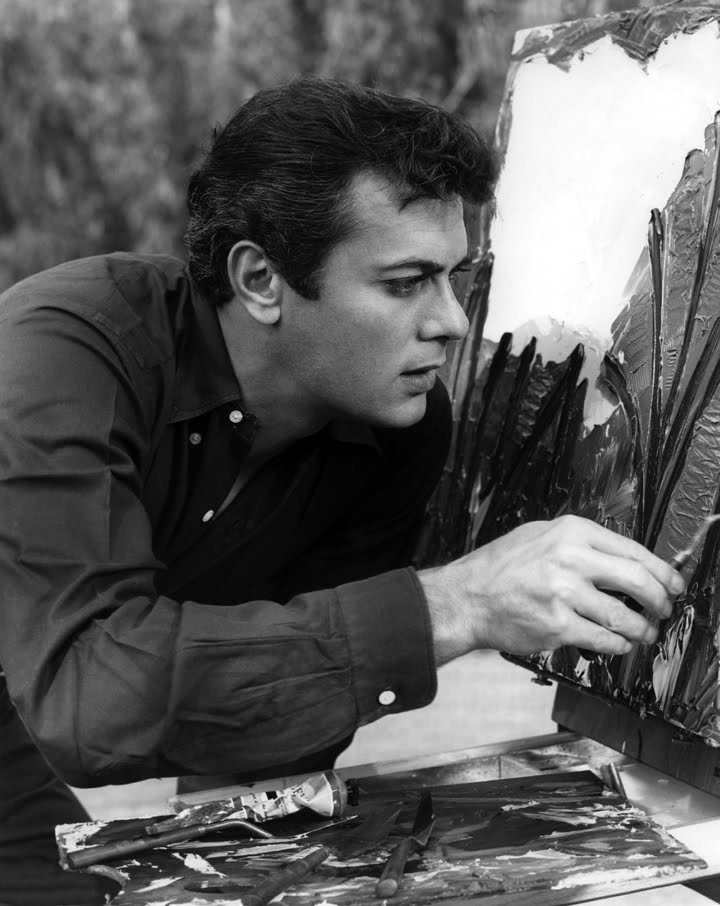
Although he’s still acting (most recently in the 2008 indie David and Fatima), Curtis devotes much of his time to his art, which encompasses painting, drawing and constructions made with found objects. His work is exhibited internationally; you can see some of his work at his Website, www.tonycurtis.com.

I visited Curtis at his home in Las Vegas in July 2009 to chat about Hollywood, art and the old neighborhood back in Manhattan.––Joe McNeill

JM: Have you ever been to Sedona?

TONY CURTIS: I’m not sure. When I was making movies as a kid with Universal, they’d send us out on location and we had locations all over Arizona.

When you were a kid in New York, you wanted to be an actor. Did you ever see a day when you’d be a full-time artist?

I never paid that much attention to it. I got into [art], but not that into it. I was going to wait for an opportunity. But you don’t sit at home and wait. You think about what else you’d like to do. I thought, well, I’d like to be an actor, so I saw a lot of movies. I’d like to be an athlete, a wrestler, so I extended myself in all these areas. I liked stories. I couldn’t write because I had a very poor education – there was no schooling of any kind – so I had no inclination toward being a writer. I had an inclination to be anything and everything I wanted, but I couldn’t because I didn’t have the ability to do it. I would have loved to have been a scientist. Couldn’t do it. A doctor. Couldn’t do it. I could have been any one of those because they all created an imagination. They were all rooted in imagination. I had an imagination. Not that that was good or bad. I had to calm my imagination because I couldn’t do [everything I wanted to do]. There were so many things I could have done.
You did a lot.

Well, I played around a lot. I had one excellent gift, which I have nothing to do with: I was the handsomest kid on the block. If I went down a block, I was the handsomest kid on the second block … and the third and the fourth. And that gave me an opportunity to step out. There were a lot of negative things about it, a lot of problem things about it, in poor neighborhoods where nobody had a nickel. I had a family that offered me money to [pretend to be] their son so they could impress some people. For a poor kid, I was very gifted. I was given a lot of gifts.

When you first signed a contract with Universal Pictures, how did that work? Did they tell you they needed you today on stage seven on the barroom set or to go grab a tuxedo, today you had to be in the crowd. Is that what you did?

Yeah, that’s what I did. I danced at the Monte Carlo in one film; in another I was a drug salesmen. I had a lot of little roles. I enjoyed those pictures. I didn’t have that much to do, and I had a chance to watch and see how pictures were made. How you got to your line, how you had to stop, how you had to turn. All of those physical things. Those were the things that helped you.

Even the B-pictures they used to make are better than most of the films being made today.

I think so. I don’t think I’ve seen a movie like Spartacus or Some Like it Hot. [Someday] they are going to make a picture with a lot of emotional attachments.

You were really a part of that last group of studio-groomed movie stars. It wasn’t the same with the people who came after you.

When I got into movies, the camera was there; we’d walk around [and] the camera would follow us. We became a piece of the set. We became a sculpture piece, only we spoke and we moved around. That’s what movies were like. Today, actors don’t move. They get into a spot and all they do is close-ups of looking. Then they cut to what they’re looking at. You could be looking at an orgy. You could be looking at a church service. You could be looking at the breakfast mother brings you. That look will work for everyone whereas when you’re in the set, it doesn’t. Your eye reflects all things.

When you were making a movie like Some Like It Hot, did you know instinctively that it was going to be a great movie?


No, there was no way I could know that. I knew there was some ground breaking [aspects]. Guys dressed up like girls, but that had been done before. There were a lot of little things that hadn’t been done – the idea that they had to escape the [St.] Valentine’s [Day] Massacre. Little sections of life. That’s what made it so appealing.

One of the things that struck me in your autobiography, American Prince, was the impact, beyond acting, that you had on popular culture. Elvis copied your hair.

Thank you for saying that. What I brought to films was a sense of not caring, a sense of naturalness. There was nothing artificial. Some actors in the method studio – Marlon Brando – took what were natural gifts and embellished them. So I came along and just didn’t do that. That gave every kid on the block the feeling that they could [act].

You influenced a number of generations. The Beatles put you on the cover of Sgt. Pepper’s Lonely Hearts Club Band.

I’m not looking for adulation or for someone to blow smoke in my ear and tell me how great I am. I know who I am and what I am. I know my weaknesses and my strengths. I’m so pleased I was able to pass this on to other people. If they had a gift of some kind, they were able to embellish it, make it part of their lives. If they could do that, they would be happy.

Do you have one movie of yours you like more than others?

The Great Race (1965). I loved that. I played honor and goodness and [Jack Lemmon] played the devil. It was the most amusing movie. I liked Sweet Smell of Success, too. Burt Lancaster was the finest actor, the most genuine man I ever knew.

You did a lot of your own stunts in Trapeze (1956).

Yes. I had an inclination for it. As I kid, I would climb up the chain links that led to the El in New York City and hitch on the back of cabs and cars and trolley cars. You see I was doing that already to prepare myself for the movies. It was hard, but I was a good athlete. I never did anything that I felt was beyond what I could do.

A lot of Trapeze is nerve-wracking because you can see it’s really you and Burt Lancaster doing the high-wire work.

Yes. Well, I did that. They showed me what to do if you fell. There was a big net underneath. I trained for about six months. I became part of the circus and it worked. I’ve had a good life. A really good life. ––Originally published in the October 2009 issue of Sedona Monthly

Wednesday, June 23, 2010

Cisco? Is that you?

Hollywood may have turned O. Henry’s Cisco Kid into “The Robin Hood of the Old West,” but that’s not quite what the writer had in mind. Here’s how he described the ­character at the start of his short story, “The Caballero’s Way”: “The Cisco Kid had killed six men in more or less fair scrimmages, had murdered twice as many (mostly Mexicans), and had winged a larger number whom he modestly forebore to count."

Poor Cisco. Not only did Hollywood whitewash his macho personality, but a few amateur historians have mixed up the locations where his sanitized adventures were put on film. Curiously, a few sources on the Internet and elsewhere have listed 1939’s The Cisco Kid and the Lady as a Sedona production, but it’s not. For starters, if any Sedona scenes were shot they didn’t make it into the final cut; it’s highly unlikely a crew would have gone there in those days, shot footage, and not used any of it. But beyond that, a search for any records of a crew coming to Sedona for Cisco Kid and the Lady in 1939 came up empty.


Before the shooting starts: Setting up a Viva Cisco Kid scene on Sedona's Schnebly Hill.

By all reliable accounts, Cisco Kid and the Lady was filmed in the Alabama Hills near Lone Pine, California. Those who say Cisco Kid and the Lady was shot in Sedona almost certainly have it mixed up with Viva Cisco Kid, which is clearly a Sedona production, a fact easily proven by viewing the film and confirmed by the extensive local newspaper coverage of the crew’s 1940 visit to town – and if you still need further evidence, just look at the ­photo above.––Joe McNeill

Thursday, June 17, 2010

Tragic Marker

If you’re under age 70, you may think “Tom Mix” is a frozen daiquiri flavoring product, but the name actually refers to Holly­wood’s onetime top movie cowboy, who appeared in close to 300 mostly silent pictures between 1909 and 1935. By the end, Mix’s career was on the skids––he was, after all, 60 years old and a little trailworn–– and he met his maker before he ever had a chance to stage the comeback that might have finally landed him in front of a camera in Sedona.

Mix entered Stiff City in Arizona, but it wasn’t a desperado or even a fiery studio mogul that did him in. He died instantly on October 12, 1940, after plunging his open 1937 Cord Phaeton convertible into a dry wash on a lonely highway near Tucson and getting brained by his flying luggage. Remarkably, it was said that despite his violent end, Mix’s body was unmarked and his white cowboy suit unwrinkled. He would have liked that.


The spot of Mix’s demise is marked with a stone monument, topped by a two-foot-tall metal cutout of a forlorn, riderless Tony, Mix’s movie horse, dedicated by singing cowboy Gene Autry in 1947. While lacking in the majesty of, say, the Washington or Lincoln Memorials, it at least take precedence as a curiosity. Today, the Tom Mix death site is part of a highway rest area; the horse cutout was unceremoniously shot full of holes at the time of my visit. The Tom Mix Memorial is located on AZ-89, 17 miles south of Florence between mile markers 115 and 116; keep an eye open for the sign; if you blink, you’ll miss it.––Joe McNeill

Thursday, June 10, 2010

He Went Looking for America...and Found it

Every one of Dennis Hopper’s obituaries acknowledged the greatest achievement of his long Hollywood career: Easy Rider, the landmark (and dope-soaked) 1969 counterculture road epic he c0-wrote, directed and starred in. A few obits even mentioned that parts of it were photographed in New Mexico, Texas, and Louisiana, but not surprisingly, none brought up the fact that some of the movie’s best scenes were filmed in northern Arizona.


Easy riders Dennis Hopper, Peter Fonda and “Stranger on highway” Luke Askew make tracks in the Painted Desert.

Easy Rider was shot on a trip from Los Angeles to New Orleans with stops in Arizona at Bellemont––the shell of the old Pine Breeze Inn, where drug dealing bikers Wyatt (Peter Fonda) and Billy (Hopper) are refused a motel room, still stands on Route 66––Wupatki National Monument (our antiheroes camp out and bogart a couple of joints among the Anasazi Indian ruins), the Painted Desert, Monument Valley and Flagstaff, where the fibreglass giant waving lumberjack on South Milton Road and the now-defunct Canyon Hotel on Leroux Street can be spotted during the main title sequence. The old adobe building near the San Francisco Peaks that once housed the Sacred Mountain Esso gas station (where the boys tank up before biking into the desert) is still there, too, although it is a stuccoed private residence today. So keep off the grass, hippies.

According to the film’s pressbook, Hopper and his crew kept on trucking until they found locations that they felt best fit the needs of their story about a man "who went looking for America and couldn’t find it anywhere.” When they discovered a photogenic spot to their liking the group would stop, set up cameras and then look for "real Americans" to add a buzz of realism to the scene.

Tuesday, June 8, 2010

G’Day…Now Go Away

In November 1995, the Australian Film Censorship Board banned screenings of Jim Jarmusch’s Dead Man, which was shot a year earlier in the Coconino National Forest, Sedona and Peaks Ranger District. The restriction, Australia’s first ban of an English language film since 1986’s Henry: Portrait of a Serial Killer, was pinned on a four-second scene that the Australian Senate Select Com­mittee on Community Stan­dards, a self-appointed body of representatives, tastefully described as “implicitly coerced” sex. The film, which starred Johnny Depp, had no such problems elsewhere, showing uncut all over the world and receiving an R rating in the U.S. Australia’s Classification Review Board subsequently overturned the ban, finding that the scene “was necessary to the narrative” and “not exploitative.” This was not the first time a Sedona-made film ran afoul of censors abroad. Both Gun Fury, a 1953 3-D western starring Rock Hudson and Donna Reed, and Shotgun, a 1955 cowboy potboiler starring Sterling Hayden and Yvonne DeCarlo, were banned in Finland for violent content.––Joe McNeill

Friday, June 4, 2010

Will You Save Zane Grey’s The Last of the Duanes?

The Last of the Duanes star George O’Brien takes in the view from Sedona’s Schnebly Hill.

Imagine having the opportunity to step back in time and see Sedona long before its development, with nothing intruding on its stunning natural scenery for as far as the eye can see. That’s what you get in 1930’s The Last of the Duanes, the first talkie shot in Sedona and the oldest surviving Hollywood feature filmed on location in Red Rock Country. Eighty-years years later, it offers an incredible historical record of the town – if we could see a clean copy. Collectors swap weak-looking bootleg DVDs, but with a little detective work, a 35mm print of Duanes was tracked down at the George Eastman House International Museum of Photography and Film in Rochester, N.Y., from which a nearly pristine exhibition print of the film could be struck – if someone steps up to underwrite the costs of the final restoration work.

For years, the film was feared lost in a 1937 fire that engulfed a Twentieth Century–Fox film vault in Little Ferry, N.J., destroying the negatives of most Fox silent films and early talkies. But when the company hired British-born Alex Gordon, a producer of B-movies such as 1956’s Shake, Rattle & Rock and 1957’s Dragstrip Girl, he instituted a restoration program that located more than 30 missing Fox films, including Duanes.

In the 1960s, Gordon parceled the studio’s remaining vault materials out to various archives for preservation. The films are believed to have been divvied up among the UCLA Film and Television Archives in Los Angeles, the Museum of Modern Art in New York and Eastman House.

Caroline Yeager, an assistant curator at Eastman House, says the museum holds a restored, tinted black-and-white nitrate print, as well as an acetate and safety negative. Its holdings would yield a clean print that could be screened in a theatre with a little more cleanup work that “I would estimate would cost between $8,000 and $10,000,” Yeager said.

We ask anyone with a serious interest in underwriting the restoration of Duanes, preserving this landmark of Sedona history for the next century, to please contact us for more information at info@sedonamonthly.com.––Erika Ayn Finch

Monday, May 31, 2010

Untrue West

The Criterion Collection’s Blu-ray release of John Ford’s Stagecoach is a keeper––the film looks better than it has in decades and the disc comes fully loaded with a strongbox full of terrific special features. Unfortunately, the old hash about John Ford’s “discovery” of what would become his favorite filming location is reheated once again in the ironically titled video supplement True West: Harry Goulding and Monument Valley.

You know the story: Indian trader Goulding, worried by the plight of his starving Navajo friends, drives 650 miles to Los Angeles in a rickety old pickup truck––much of the trip on bumpy, unpaved dirt roads, mind you––armed with snapshots of the completely unknown Monument Valley to insist that Ford shoot his new Western there. Ford immediately snaps at the bait, flying pronto to Arizona with a crew of dozens of people–– in one version of the tale he even beat Goulding back to Monument Valley––to heroically save the Navajo and create an iconic American movie location.


At least that's the way it happened inside the brain of an ingenious studio flack. After spending more than seven years delving into the movies made in northern Arizona I haven’t uncovered a shred of proof that Harry Goulding had anything more to do with Stagecoach than renting the basement of his trading post as dorm room for a handful of crew laborers. Ford and the movie’s other top dogs didn’t even bunk in Monument Valley during filming, they stayed at the actual base of operations, the Wetherill and Colville Trading Post and Lodge in Kayenta, twenty-five miles away. So if Harry Goulding brought together John Ford and Monument Valley, why wasn’t his trading post leased as company headquarters? That seems to be the least Ford could have done to reward Goulding for the trouble he had allegedly taken to broker the deal. What’s more, if Goulding had played such a vital role in bringing Ford to Monument Valley, why was his Navajo rescue mission––surely a press agent's dream story––not mentioned in print until 1953, fourteen years after Stagecoach rolled into theaters and, conveniently, both Wetherill and Colville were dead?

Stagecoach is one of the great Hollywood films, written about and analyzed since the day it hit theaters in 1939, so it boggles the mind that no historian has taken the time to sniff around Flagstaff to dig up the truth about how it was created. The Coconino Sun, the town’s only newspaper in those days, covered Stagecoach‘s production from the moment Ford first came to northern Arizona to scout locations right up to its world premiere engagement––in Flagstaff, by the way, and not Los Angeles (that’s another reality long ignored by historians, but a story to save for another time).


So here are a few documentable, but less than legendary facts: In late September 1938, Flagstaff rancher Lee Doyle, who’d worked as Hollywood’s northern Arizona contact man since 1923, received a telegram from Stagecoach’s production manager asking him to help “look for locations in the Painted Desert and in Monument Valley.”

A week later The Coconino Sun reported that Ford and his associates met Doyle in Flagstaff to begin selecting locations and to make arrangements for bringing in a company of actors and technicians. Ford, Doyle and the rest of the Hollywood group checked into Wetherill and Colville’s in Kayenta; their signatures in the Lodge’s guest register, which survives in the Wetherill family archive, prove the scouting party stayed there for the remainder of their three day visit and not at Goulding’s in Monument Valley. Ford returned to Wetherill and Colville’s when filming began and he shacked there for the entire time he was on location. It's interesting to note that even though some spillover crew members were housed at his trading post, Harry Goulding wasn’t once mentioned by name during the three weeks The Coconino Sun covered Arizona filming.

There are a few other pesky details about the making of Stagecoach that have been ignored by the Ford/Goulding/Monument Valley mythologizers, including MGM records that confirm the studio had a film crew shooting second unit exteriors in Monument Valley for its Mickey Rooney sitcom Out West with the Hardys five weeks before Ford ever laid eyes on the place. What’s more, according to multiple Coconino Sun reports, Sedona was included as one of Stagecoach’s Arizona filming locations, chosen after Ford and his party made “motor trips over the Indian reservation and through Oak Creek Canyon, selecting sites for the different phases of the contemplated picture.” Sorry, movie fans, this buzz isn’t just spin–– it’s fact.––Joe McNeill