Monday, March 21, 2011

Total Pre-Call, Part 6

In 1921, Zane Grey bought three acres of land on Anderson Lee “Babe” Haught’s homestead in Arizona’s Tonto Basin to build a hunting cabin. “This is where I want my lodge so I can see as far as the eye can see,” Grey wrote. “Beautiful country! And this is where I am going to write a lot of my books.” Haught, who’d worked as Grey’s wilderness guide on the Mogollon Rim since 1918, built the lodge on the designated spot, which lies today within the gated Zane Grey Ranch subdivision in Payson; Grey’s cabin burned to the ground in 1990, but a replica was reconstructed in Payson’s Green Valley Park 15 years later.

The Los Angeles Times reported on April 16, 1923, that Victor Fleming and Famous Players-Lasky production executive Lucien Hubbard (who would oversee most of the company’s silent Zane Grey productions and be credited for writing the scenarios of seven of them) left Hollywood for Tonto Basin to scout filming locations for To the Last Man. At the same time, Grey wrote to Babe Haught, telling him he’d leased his cabin to the film company and requesting that he give the crew a hand with the production. Haught would service Last Man filmmakers by supplying local laborers, extras, horses and location expertise in the same way that Flagstaff rancher Lee Doyle, Grey’s trusted wilderness guide in northern Arizona, would for The Call of the Canyon, The Vanishing American and the dozens of films made in Sedona into the late 1950s.
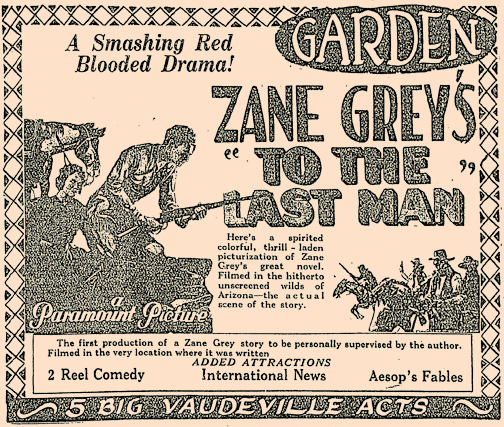
Haught and his men went to work right away, building a camp of tent houses to lodge the film company and a log cabin that would be used for a few scenes in the picture. An exact reproduction of a pioneer settlement was also built “down below Payson” by Famous Players-Lasky carpenters assisted by a group of local axmen who hewed logs. The lower stories of the 12 buildings were built of stone; logs and rough hewn boards and shingles were used to complete the structures.

Last Man would be hyped by the studio with claims that some of the Tonto Basin residents hired as extras were descendants of the Pleasant Valley War’s “real last man” and that these mountaineers actually looked their parts before cameras started cranking. Arriving on location with period clothing to dress up the locals as 1880s pioneers, studio costumers were dismayed to discover that the everyday clothes worn by some of the extras looked more authentic than the actors’ costumes, claiming “from high-heeled riding boots, to sombreros, each man looked as if he might have stepped off a Broadway stage where some play of frontier days was being produced.”–––Joe McNeill © 2011 Bar 225 Media Ltd.

Monday, March 14, 2011

Total Pre-Call, Part 5

Lois Wilson and Richard Dix on location at Tonto Basin.
Surviving Famous Players-Lasky press materials have left us with a pretty good idea of what Roaring Twenties audiences saw in To the Last Man. As the picture opens, Gaston Isbel (Robert Edeson) accuses Lee Jorth (Fred Huntley) of cattle rustling and threatens the latter with punishment when his son, Jean (Richard Dix), arrives from Oregon. Jean, he says, has no equal when it comes to tracking down cattle thieves.

On the way to his father’s ranch, Jean meets Jorth’s daughter, Ellen (Lois Wilson), and smitten in a flash, impulsively kisses her. When Ellen learns the stranger is Jean Isbel, forgiveness becomes an impossibility – a Jorth can’t cozy up to an Isbel. Nevertheless, Ellen soon realizes she loves Jean, despite the conflict between their families.

Meanwhile, back at the Jorth ranch, Lee Jorth and his men, Diggs (Edward Brady), Colter (Noah Beery), Queen (player unknown) and others, discuss Jean’s coming and see trouble brewing. Simms Bruce (gravelly voiced character actor Eugene Palette, billed here as “Jean Palette”) starts the feud anew by shooting at Gaston Isbel. Some of Isbel’s cattle are stolen, among them Jean’s horse, Whiteface. It is upon meeting Jean, who recognizes his mount, which has been given to the girl by her father, that Ellen realizes that Jorth is in reality a horse thief. She returns to the ranch denouncing her father and his men. They learn of Jean’s tracking them and immediately set out to raid the Isbels.

Guy Isbel (Leonard Clapham, later known as Tom London) is shot down and a siege follows. At last, Gaston Isbel realizes the awful consequences of his selfish hate. As the Jorths start to leave, Gaston tells of his decision to follow Jorth, kill him and put an end to the feud, fighting to the last man.

Isbel is tricked and shot down by one of the Jorth men. Blue (Frank Campeau), a confederate, takes command, killing Jorth. A chase ensues, ending in the huge explosion of a planted mine at the foot of the painted cliffs. After this calamity, the only Isbel remaining alive is Jean, who, badly injured, makes his way to a cabin, where he hides in the loft.

Meanwhile, news of her father’s death at the hands of the Isbels has reached Ellen. She goes with Colter to find her father’s body, but Colter, who has less than honorable intentions, leads her to a lonely cabin where, unknown to him, Jean has found shelter. Ellen sees blood on the rung of the ladder leading up to the loft, and becomes aware of Jean’s presence. She tries to conceal this from Colter, and when he discovers her trick she offers herself in exchange for Jean’s life. She confesses her love for Jean.

Jean’s presence is discovered by Colter and as he is about to climb the ladder Ellen shoots and kills Colter. Jean’s pursuers arrive and for a time Jean and Ellen are at their mercy. But at the critical moment, a posse arrives and the gang is forced to surrender. Jean tells Ellen that the feud is over. True love prevails and they embrace at fade-out.–––Joe McNeill © 2011 Bar 225 Media Ltd.

Monday, March 7, 2011

Total Pre-Call, Part 4

Lois Wilson in costume for To the Last Man.

To the Last Man’s top-billed Lois Wilson would also play the lead female roles in The Call of the Canyon and The Vanishing American. She became a major star in the late silent period; some of her other significant roles were in Monsieur Beaucaire (1924) opposite Rudolph Valentino, and as Daisy Buchanan in the first film version of F. Scott Fitzgerald’s The Great Gatsby (1926). Besides starring in To the Last Man and The Call of the Canyon, Richard Dix had major roles in six other films released during 1923 and would star in The Vanishing American two years later. Before filming began on Last Man, Zane Grey took his children to see a film in which Dix appeared and he later wrote to his wife, “we went to the movies last night, and took the kids. Luckily the show was decent. We saw Richard Dix (the man who’s playing Jean Isbel in my forest story) and I must say that I like him very much.”

During Last Man filming, gossip columnists began to link Dix and Wilson romantically and for a few months they apparently did have an off-screen relationship. “Why didn’t I marry him in real life?” a pensive Lois Wilson reflected to author John Tuska for his 1976 book The Filming of the West. “Maybe, ultimately, because I was so very close to my family. But I didn’t think so at the time. I remember while we were shooting To the Last Man, Vic Fleming wanted to go to the Grand Canyon for some scenic locations. We were camped on the floor and had to ride these small but wiry little mountain ponies up a steep path carved out of the side of the canyon wall. There was scarcely enough room for one horse; one slip, and rider and horse would plunge over the side.

“Well, I was a good rider. I went up that narrow trail with the others and enjoyed it. After a couple of days, I figured, I could do it without holding my breath. Dick didn’t want me to make the ride. But I went anyway. Then, when we got to the top, he came over to where I was sitting on my horse and he asked me if I had been afraid.

“‘Not at all,’ I told him bravely.

“‘I don’t think I could love a woman who wasn’t afraid of a thing like that ride,’ he said.

“‘You can’t love me,’ I returned, ‘because I wasn’t afraid.’

“By the time we made our next picture, he was right; the romance had cooled.” 

Half a century later, catty silent movie queen Leatrice Joy bared her claws when she suggested a less sentimental reason for the demise of her old friend’s affair with Dix. “I think it was the drinking that ruined them,” she gossiped to Talking to the Piano Player author Stuart Oderman in 1970. “They were never drunk at the same time. In Hollywood, everything is timing.”


Supporting actors Noah Beery, Fred Huntley and Leonard Clapham would appear in To the Last Man and The Call of the Canyon, and both films would have at least two crew members in common. Cameraman James Wong Howe, billed as James Howe, was a pioneer, a Chinese-American working on major Hollywood productions. He would go on to earn 10 career Oscar nominations, winning twice. Although some modern sources name Bert Baldridge as Last Man’s co-cameraman, contemporary crew lists don’t mention him, so it’s more likely that he worked as Howe’s assistant.

Scenario writer Doris Schroeder was assigned to adapt Last Man for the screen, and curiously, a studio-generated news item seems to badmouth Grey’s writing ability to build up hers, insisting that not only did she incorporate the major elements of his story “but also, where good judgement decreed, inserted certain scenes or revised others as her experience as an adaptor dictated.” Schroeder would be credited (with Edfrid A. Bingham) as co-writer of the movie version of The Call of the Canyon.–––Joe McNeill © 2011 Bar 225 Media Ltd.

Monday, February 28, 2011

Total Pre-Call, Part 3

Filming To the Last Man at Tonto Basin in 1923 are (standing, from left) unknown, James Wong Howe, Richard Dix, Lois Wilson and Victor Fleming.
By November 1922, Zane Grey had reached his boiling point over the movie industry’s “creative accounting” practices (net profit deals in Hollywood are still a sucker’s bet) and filed suit against his partners in Zane Grey Pictures, charging them with fraud and diversion of funds. He alleged that most of the profits from the seven films made by the company had been pocketed by Hampton and Warner and that he had not received the 25 percent share stipulated in his contract.

Declaring Zane Grey Pictures a bust, he sold the bones of the business a month later to Famous Players-Lasky Corporation, the earliest incarnation of Hollywood titan Paramount Pictures. It was a good deal for both sides: Grey would be paid $25,000 upfront for a seven-year option on each title, with a share in the pictures’ profits; in return, the studio could prominently promote Grey’s name on its Westerns, which would help ensure big box-office returns.

Reporting on the Grey/Famous Players–Lasky deal in January 1923, The New York Times correctly noted that Grey would “collaborate actively” on the “picturization” of his stories. Three months later, the Times mistakenly claimed that Grey would direct To the Last Man, the first of his books to be filmed under the arrangement, when in fact, the studio planned to assign the job to contract director Victor Fleming. The idea was to have Fleming shoot Last Man in Tonto Basin, then take the identical cast and crew in quick succession to Oak Creek Canyon to film Grey’s The Call of the Canyon and then to Tuba City for Grey’s The Vanishing American, each location the actual setting of the novel. Fleming was already familiar with the Arizona landscape, having directed parts of The Mollycoddle, a 1920 comedy with Douglas Fairbanks, on the Hopi reservation. As it happened, things didn’t pan out in quite the way the studio had hoped; after two years of production delays, Fleming became involved with other projects and The Vanishing American was directed by serial veteran George B. Seitz. Fleming would later achieve silver screen immortality by directing both The Wizard of Oz and Gone with the Wind in 1939.

Richard Dix and Lois Wilson pose on the Mogollon Rim.
Studio production chief Jesse L. Lasky himself made the announcement that Lois Wilson and Richard Dix, two of his company’s hottest up-and-coming young stars, would be teamed for the first Zane Grey pictures. At the same time, he loudly tooted his horn about how Last Man would be photographed at the book’s backdrop of Tonto Basin, about 90 miles northeast of Phoenix, which he dramatically described as “one of the most difficult spots of access in the entire United States.” Lasky wasn’t just whistling Dixie about the tough commute facing his film crew; as late as the early 1950s, it was still a 10-hour car trek on mostly unpaved roads from Phoenix to Tonto Basin.–––Joe McNeill © 2011 Bar 225 Media Ltd.

Monday, February 21, 2011

Total Pre-Call, Part 2

To the Last Man star Richard Dix at Arizona's Mogollon Rim.

It was probably in the late teens that Zane Grey began work on what would become To the Last Man, his fictionalized account of the real-life Graham-Tewksbury feud, aka the Pleasant Valley War, the bloodiest conflict between cattlemen and sheepmen in the history of the West. The violence began in 1886 in central Arizona’s Tonto Basin region (today a district within Gila County) and reached a deadly climax when the last of the Graham family was murdered in Tempe in 1892. Historians estimate that about 20 deaths can be directly linked to the vendetta.

According to an item in the March 18, 1922, issue of the American Library Association Booklist magazine, Grey made three trips to Tonto Basin to dig out “the truth” about the feud. In an October 1930 letter to Flagstaff’s Coconino Sun newspaper, he estimated he’d spent $30,000 – a king’s ransom in those days – just on research.

Dying on his feet, Blue (Frank Campeau) tells Jean Isbel (Richard Dix) that he has killed two enemies in Last Man.
Grey titled his novel Tonto Basin and added a fabricated backstory that revolved around the illegitimate birth of heroine Ellen Jorth. In his reimagined version of history (so much for “the truth”), it is the lustful behavior of her parents, members of opposing clans who live together without ever marrying, that triggers the bad blood between the two families. The Country Gentleman magazine paid Grey $30,000 for serialization rights to the novel, but nervous editors cut out every last trace of hanky-panky and retitled it the ballsier-sounding To the Last Man when they rolled out the story in 10 parts during 1921. Harper and Brothers later published The Country Gentleman version as a book, and it went on to become, according to Publishers Weekly, the ninth biggest selling American novel of 1922. The sexy plot elements homogenized by The Country Gentleman would finally be restored when the novel was reissued in 2004 under Grey’s original title, Tonto Basin.–––Joe McNeill © 2011 Bar 225 Media Ltd.

Monday, February 14, 2011

Total Pre-Call, Part 1

Arizona’s Little Hollywood, the definitive history of the starring role Sedona played in the movies, focuses on the high desert country that stretches from Oak Creek Canyon to Monument Valley to the Grand Canyon (ground zero for filmmaking in northern Arizona), which effectively put the kibosh on detailed coverage of any films photographed in other parts of the state. So the making of 1923’s To the Last Man – big brother movie to The Call of the Canyon, the first one to have a Sedona pedigree – is given just a quick once-over because it was shot in central Arizona, about 50 miles southeast of Red Rock Country. This long-lost silent film may be a ghost, but it didn’t take all its secrets to the grave. The backstory of To the Last Man, which hit theaters while virtually the identical cast and crew was in Oak Creek Canyon to shoot The Call of the Canyon, deserves to be remembered as the prequel to Sedona’s rise as a popular movie location. Consider it the lost chapter of Arizona’s Little Hollywood; here’s the first of an 11-part series that completes the story.

Last Man, like Call, was based on a novel by Zane Grey, and it kickstarted a long-term deal with Paramount Pictures that would, in the minds of some critics, result in the best films ever made from his writings. But for Grey, a former dentist who became one of the most popular authors of the 20th century, success in the movies didn’t come painlessly. In 1916, after two years of trying to rustle up interest for his books in Hollywood, he sold all rights forever – including for television, which may have seemed about as likely to ever happen as landing a man on the moon – to Riders of the Purple Sage, The Rainbow Trail, The Last of  the Duanes and The Lone Star Ranger to Fox Film Corporation. But it wasn’t long before he was kicking himself for having let them go for a measly $2,500 apiece. It was crystal clear that there was a lot of money to be made adapting his work to the movies, so in 1918 he decided to cut out the middleman and make the films himself, forming Zane Grey Pictures Inc. in partnership with producers Benjamin B. Hampton and Eltinge F. Warner. It must have struck Grey as a no-lose proposition; he would retain ownership of his stories, oversee the content of the films and share in their profits, but not have to actively participate in making them.


Audiences lined up to see Zane Grey Pictures’ first release, Desert Gold (1919), based on his 1915 novel; Motion Picture News reported it did such boffo business that a few sly exhibitors took advantage of public demand to see it as a sneaky way to permanently raise ticket prices. Mysteriously, even though Grey was now calling the shots, his longstanding wish to have his novels filmed at the exact locations he wrote about (a request that consistently fell on deaf ears at Fox Film) was ignored for this one, too; most of Desert Gold was photographed in Palm Springs, Calif., even though his original story was set on the Arizona-Mexico border. Still, Grey seemed to be satisfied with the way his initial dabbling into the movie business had turned out. Advertising included his portrait and signed testimony that “The producer has put the spirit, the action and the truth of Desert Gold on the screen. My ideas, my wishes – even my hopes – have been fulfilled.”–––Joe McNeill © 2011 Bar 225 Media Ltd.

Monday, February 7, 2011

Shirley, You’re Mistaken...

Heroic George O'Brien protects Shirley Nail in Riders of the Purple Sage.

Over the years, a number of reports in the Arizona press have repeated a fanciful tale of curly-haired moppet Shirley Temple going to Sedona in 1931 for a role in Fox Film’s second remake of Zane Grey’s Riders of the Purple Sage. Cute, but not true. Temple, the most famous child star in movie history, never made a film in Sedona; the little girl who played in Riders was a 3-year-old named Shirley Nail.

Riders was filmed in 1931; Temple did not make her screen debut until the following year, an uncredited appearance in The Runt Page, a 1932 Educational Pictures “Baby Burlesks” short directed by Ray Nazarro, who also helmed the Sedona-made 1952 Indian Uprising starring George Montgomery. In 1933, Temple had an uncredited bit in a Randolph Scott western based on Zane Grey’s To The Last Man, filmed at Big Bear Lake, Calif. Her one pertinent link to Riders of the Purple Sage: Its director, Hamilton MacFadden, directed Temple’s star-making turn in Fox’s 1934 musical comedy Stand Up and Cheer. Temple appeared in only one Western after To The Last Man, John Ford’s 1948 Fort Apache, when she was 19.

Not much is known about Shirley Nail, who seems never to have been in another film. Critics of the day took note of the little platinum blonde haired girl, although even then there was some confusion about her name. Nelson B. Bell wrote in The Washington Post that Riders’ supporting cast “...all contribute effective support, but none with quite the charm of little Shirley Nails, a precocious and precious baby.” Variety’s “Sid” noted the film is “...entirely void of comedy other than for the antics of the diminutive Miss Niles.”––Joe McNeill